Opinion

Kegan, Teach, Rao: Stages of Moral Development

​I recently read Chapman’s texts on Robert Kegan’s levels of moral development and meaning-making, namely: Developing ethical, social, and cognitive competence and the more psychedelic What is stage five (like)?. Scott Alexander also has some interesting thoughts on the first one.
Wikipedia has a nice table showing how Kegan compares the levels to other systems like Maslow’s hierarchy of needs. While the equivalence seems somewhat forced, there’s still certainly something going on here. And the thing likely isn’t “everything should always be divided neatly into five phases”.
I have read some other so-called psychoanalytic texts that discuss meaning-making, and some of them resonate with Kegan rather interestingly. Two primary pieces are Sadly, Porn, Edward Teach’s (not the pirate) masterpiece on Lacanian psychoanalysis, and the superb guide to meta-level office politics, The Gervais Principle by Venkatesh Rao.
The rest of the text might be largely inscrutable unless you’ve read these, although you can mediate Sadly with Scott’s excellent review.

I’ll go through Kegan’s levels quickly, but Chapman does it better so I won’t bother too hard.
The first two are largely irrelevant for adults. On the first level, the concept of self as a separate entity hasn’t properly formed yet (theory of mind), and as such it’s rather useless to talk about morality. The second level is almost purely self-interested and other people are largely seen instrumentally. Self-worth is primarily defined by explicit feedback from caretakers.
On the third level, things get interesting. Meaning is derived from the community. Conforming to social expectations and norms is important; “what others think of me?” is the most important aspect. None of this is reflective. People on the third level do not form explicit strategies to win social games.
Fourth level is characterized by systems instead of people, experiences and feelings. You can decide who you are, what you think, and how you react. Ethical and political frameworks that are based on principles instead of outside approval. Identity is based on roles that one plays, systems that one uses. Professionalism. Reflection becomes possible.
What the fourth level does to the third, the fifth doesn’t do to the fourth. On the fifth level you can ambivalently inspect the world from multiple perspectives without committing to any. Lightness. Nuance. No pressure to collapse complex phenomena onto a single axis like good/bad. Toolbox mentality. “All systems are wrong, some are useful”, not as a dogma, but an actual thought-pattern. The internal narrator becomes self-aware and breaks the fourth wall.
Between the last two, there also lives stage 4.5, where one realizes that any and all systems are not grounded on anything. Nihilism is the typical reaction here, and that’s how I experienced it too, before it evolved into moral nihilism and some nuance.
I find Chapman’s formulation of the fifth level a bit too Buddhism-flavored for me. Some of the concepts like “becoming the space” and “decentered in time” simply do not resonate
[1]
. But then again, he also definitely gets it. The way one reaches higher levels leaves its mark on thought-patterns and vocabulary. We might just have different aesthetics.

The first observation for seeing these levels as moral instead of purely developmental is mapping them to pre-existing terms. My interpretation goes somewhat like this:

No morality – no concept of self
Egoism / hedonism
Implicit virtue ethics without generalization
Explicit systems like consequentialism, utilitarianism
Lightness, ambivalence, nuance

Ordinary nihilism can go between #4 and #5. My take is that moral nihilism goes in #5.

Time to railroad this into Teach’s Lacanian framework.
Teach’s core thesis is that people want someone else to be the “adult in the room”. To exemplify this, I’ll quote Scott’s review on this instead of taking the responsibility myself:

Psychologically healthy people have desires. Sometimes they fantasize about these desires, and sometimes they act upon them. You’ve probably never met anyone like this.

Psychologically unhealthy people, eg you and everyone you know, don’t have desires, at least not in the normal sense. Wanting things is scary and might obligate you to act toward getting the thing lest you look like a coward. But your action might fail, and then you would be the sort of low-status loser who tries something and fails at it.

So instead, you spend all your time playing incredibly annoying mind-games with yourself whose goal is to briefly trick yourself into believing you are high status. Everyone else, so far as you even recognize their existence at all, is useful only as a pawn in this game.

Kegan’s second stage doesn’t have this problem
[2]
, as one doesn’t feel the invisible audience’s Gaze
[3]
. It’s the third stage that activates it. Coolness is derived from conformity, which is subsequently internalized because that’s easier both energy- and skill-wise compared to acting cool without internalization.
Upon entering the fourth stage, the influence of the peer group gives way to more complex structures. Status still plays a big part, but it’s more and more tied to one’s position in hierarchical systems, like job title or net worth. One assumes new roles, like political affiliation, educational level, socioeconomic class, moral philosophy framework, and parenthood. Identity is mostly seen through these.
Transitioning to the fifth level transmutes these roles from identities to tools or descriptions. Self dissolves enough that there’s no fixed point for the Gaze to focus on. Failure is no longer a problem to be feared, and rather a risk to be mitigated.

We can next try mapping Loser, Clueless, and Sociopath from The Gervais Principle to Kegan’s levels. Clueless is the easiest to map: incapable of reflection, lives in the social reality and self-concept is built on external validation. While identifying with a system is clearly a level 4 trait, the Clueless are in it for social conformity and not because they’ve learned an explicit system and committed to it. They over-identify with their organization-assigned roles.
The Loser somewhat matches level 4. They maintain an identity separate from the institution. They have principles.
And the Sociopath matches level 4.5. Rao describes how the 3rd and 4th level systems are discarded:

Amorality is merely the first step. As the journey proceeds, Sociopaths progressively rip away layer after layer of social reality. The Sociopath’s journey can be understood as progressive unmasking of a sequence of increasingly ancient and fearsome gods, each reigning over a harsher social order, governing fewer humans. If morality falls by the wayside when the first layer is ripped away, other reassuring certainties, such as the idea of a benevolent universe, and predictable relationships between efforts and rewards, fall away in deeper layers.

With each new layer decoded, Sociopaths find transient meaning, but not enduring satisfaction.

Much to their surprise, however, they find that in the unsatisfying meanings they uncover, lie the keys to power over others. In seeking to penetrate mediated experiences of reality, they unexpectedly find themselves mediating those very realities for others. They acquire agency in the broadest sense of the word. Losers and the Clueless delegate to them not mere specialist matters like heart surgery or car repair, but control over the meanings of their very lives.

Note that both Teach and Rao present pathological models. Neither contain an equivalent to Kegan’s fifth, “healthy” level. The enduring satisfaction is what is required here. Chapman somewhat covers this.

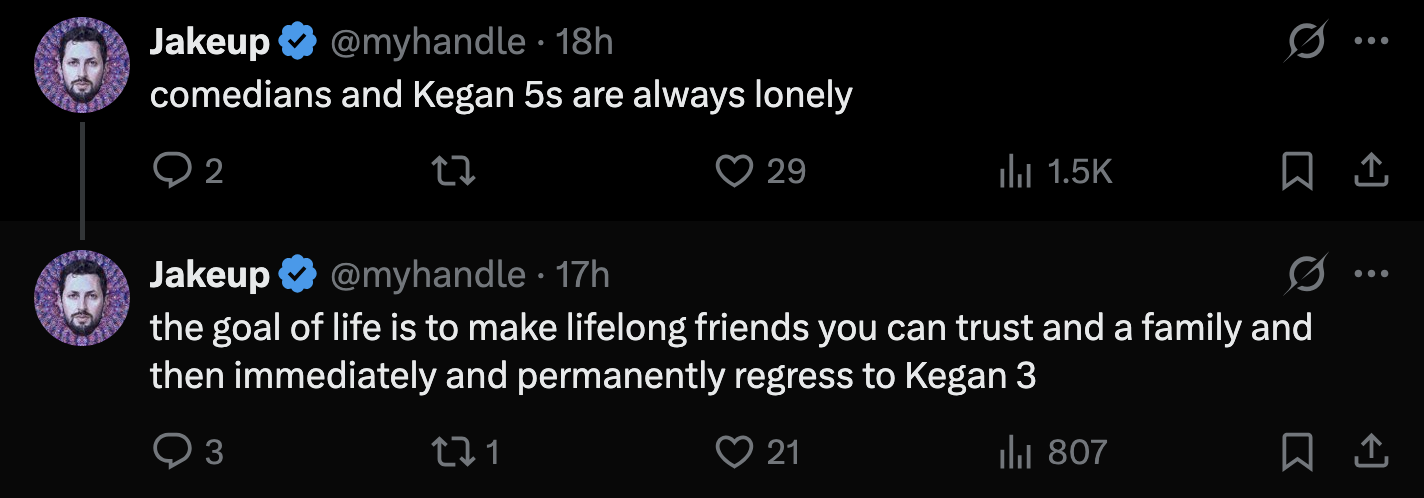
An important to note is that both Chapman and to some extent Rao seem to be quite absolute about these stages and roles. In reality, transitioning to the next stage isn’t instant, and a person can be on different stages depending on context or mood. For instance, it’s often the case for children that they’re on stage 3 while in school context, but still on stage 2 at home. An adult could have different stages for work and home life. This is especially true for Rao’s model of Loser and Sociopath, where one might pick their role based on their social status and Powertalk skill level on a case-by-case basis.

I’m definitely not at fifth level yet, not fully. I can see glimpses. On a good day, I don’t even have to exert myself too much to chill in the lightness of it. And then something unexpected occurs and it knocks me down to level four. Or two.
I’m also definitely not immune to social pressure, as much as I enjoy pretending otherwise. In theory, one could do neutral analysis, cost-benefit calculations, and value-preserving reflection before deciding on the course of action. With enough stress about this I’m unable to sustain the fifth stage. Regressing to third stage means that not looking weird, or whatever, collapses from an instrumental to a terminal value. Fourth stage merely means I fall back on my well-practiced roles.
Other sources of stress sometimes do this too. When I’m panicking about a deadline or worrying that I made a mistake, or lack enough stuff from Maslow’s, it can also happen.
Another typical way to regress to the fourth level is discussing ethics or politics. Once you have to verbalize your arguments for a position, it saves a lot of words and energy to reach for a pre-existing and well-known framework like utilitarianism, capitalism, or human rights. Especially when someone else does that first. Especially when pointing out a contradiction in their model.

Kegan is of the opinion that nobody gets to the stage five before the age of forty. Not that I lack the arrogance to think I’m almost there.
To be fair, he admits that the sounds like he’s on drugs. ↩︎

Typically there’s an actual adult in the room too. ↩︎

I’m borrowing the word directly from Lacan. ↩︎

Discuss ​Read More

Kegan, Teach, Rao: Stages of Moral Development

​I recently read Chapman’s texts on Robert Kegan’s levels of moral development and meaning-making, namely: Developing ethical, social, and cognitive competence and the more psychedelic What is stage five (like)?. Scott Alexander also has some interesting thoughts on the first one.
Wikipedia has a nice table showing how Kegan compares the levels to other systems like Maslow’s hierarchy of needs. While the equivalence seems somewhat forced, there’s still certainly something going on here. And the thing likely isn’t “everything should always be divided neatly into five phases”.
I have read some other so-called psychoanalytic texts that discuss meaning-making, and some of them resonate with Kegan rather interestingly. Two primary pieces are Sadly, Porn, Edward Teach’s (not the pirate) masterpiece on Lacanian psychoanalysis, and the superb guide to meta-level office politics, The Gervais Principle by Venkatesh Rao.
The rest of the text might be largely inscrutable unless you’ve read these, although you can mediate Sadly with Scott’s excellent review.

I’ll go through Kegan’s levels quickly, but Chapman does it better so I won’t bother too hard.
The first two are largely irrelevant for adults. On the first level, the concept of self as a separate entity hasn’t properly formed yet (theory of mind), and as such it’s rather useless to talk about morality. The second level is almost purely self-interested and other people are largely seen instrumentally. Self-worth is primarily defined by explicit feedback from caretakers.
On the third level, things get interesting. Meaning is derived from the community. Conforming to social expectations and norms is important; “what others think of me?” is the most important aspect. None of this is reflective. People on the third level do not form explicit strategies to win social games.
Fourth level is characterized by systems instead of people, experiences and feelings. You can decide who you are, what you think, and how you react. Ethical and political frameworks that are based on principles instead of outside approval. Identity is based on roles that one plays, systems that one uses. Professionalism. Reflection becomes possible.
What the fourth level does to the third, the fifth doesn’t do to the fourth. On the fifth level you can ambivalently inspect the world from multiple perspectives without committing to any. Lightness. Nuance. No pressure to collapse complex phenomena onto a single axis like good/bad. Toolbox mentality. “All systems are wrong, some are useful”, not as a dogma, but an actual thought-pattern. The internal narrator becomes self-aware and breaks the fourth wall.
Between the last two, there also lives stage 4.5, where one realizes that any and all systems are not grounded on anything. Nihilism is the typical reaction here, and that’s how I experienced it too, before it evolved into moral nihilism and some nuance.
I find Chapman’s formulation of the fifth level a bit too Buddhism-flavored for me. Some of the concepts like “becoming the space” and “decentered in time” simply do not resonate
[1]
. But then again, he also definitely gets it. The way one reaches higher levels leaves its mark on thought-patterns and vocabulary. We might just have different aesthetics.

The first observation for seeing these levels as moral instead of purely developmental is mapping them to pre-existing terms. My interpretation goes somewhat like this:

No morality – no concept of self
Egoism / hedonism
Implicit virtue ethics without generalization
Explicit systems like consequentialism, utilitarianism
Lightness, ambivalence, nuance

Ordinary nihilism can go between #4 and #5. My take is that moral nihilism goes in #5.

Time to railroad this into Teach’s Lacanian framework.
Teach’s core thesis is that people want someone else to be the “adult in the room”. To exemplify this, I’ll quote Scott’s review on this instead of taking the responsibility myself:

Psychologically healthy people have desires. Sometimes they fantasize about these desires, and sometimes they act upon them. You’ve probably never met anyone like this.

Psychologically unhealthy people, eg you and everyone you know, don’t have desires, at least not in the normal sense. Wanting things is scary and might obligate you to act toward getting the thing lest you look like a coward. But your action might fail, and then you would be the sort of low-status loser who tries something and fails at it.

So instead, you spend all your time playing incredibly annoying mind-games with yourself whose goal is to briefly trick yourself into believing you are high status. Everyone else, so far as you even recognize their existence at all, is useful only as a pawn in this game.

Kegan’s second stage doesn’t have this problem
[2]
, as one doesn’t feel the invisible audience’s Gaze
[3]
. It’s the third stage that activates it. Coolness is derived from conformity, which is subsequently internalized because that’s easier both energy- and skill-wise compared to acting cool without internalization.
Upon entering the fourth stage, the influence of the peer group gives way to more complex structures. Status still plays a big part, but it’s more and more tied to one’s position in hierarchical systems, like job title or net worth. One assumes new roles, like political affiliation, educational level, socioeconomic class, moral philosophy framework, and parenthood. Identity is mostly seen through these.
Transitioning to the fifth level transmutes these roles from identities to tools or descriptions. Self dissolves enough that there’s no fixed point for the Gaze to focus on. Failure is no longer a problem to be feared, and rather a risk to be mitigated.

We can next try mapping Loser, Clueless, and Sociopath from The Gervais Principle to Kegan’s levels. Clueless is the easiest to map: incapable of reflection, lives in the social reality and self-concept is built on external validation. While identifying with a system is clearly a level 4 trait, the Clueless are in it for social conformity and not because they’ve learned an explicit system and committed to it. They over-identify with their organization-assigned roles.
The Loser somewhat matches level 4. They maintain an identity separate from the institution. They have principles.
And the Sociopath matches level 4.5. Rao describes how the 3rd and 4th level systems are discarded:

Amorality is merely the first step. As the journey proceeds, Sociopaths progressively rip away layer after layer of social reality. The Sociopath’s journey can be understood as progressive unmasking of a sequence of increasingly ancient and fearsome gods, each reigning over a harsher social order, governing fewer humans. If morality falls by the wayside when the first layer is ripped away, other reassuring certainties, such as the idea of a benevolent universe, and predictable relationships between efforts and rewards, fall away in deeper layers.

With each new layer decoded, Sociopaths find transient meaning, but not enduring satisfaction.

Much to their surprise, however, they find that in the unsatisfying meanings they uncover, lie the keys to power over others. In seeking to penetrate mediated experiences of reality, they unexpectedly find themselves mediating those very realities for others. They acquire agency in the broadest sense of the word. Losers and the Clueless delegate to them not mere specialist matters like heart surgery or car repair, but control over the meanings of their very lives.

Note that both Teach and Rao present pathological models. Neither contain an equivalent to Kegan’s fifth, “healthy” level. The enduring satisfaction is what is required here. Chapman somewhat covers this.

An important to note is that both Chapman and to some extent Rao seem to be quite absolute about these stages and roles. In reality, transitioning to the next stage isn’t instant, and a person can be on different stages depending on context or mood. For instance, it’s often the case for children that they’re on stage 3 while in school context, but still on stage 2 at home. An adult could have different stages for work and home life. This is especially true for Rao’s model of Loser and Sociopath, where one might pick their role based on their social status and Powertalk skill level on a case-by-case basis.

I’m definitely not at fifth level yet, not fully. I can see glimpses. On a good day, I don’t even have to exert myself too much to chill in the lightness of it. And then something unexpected occurs and it knocks me down to level four. Or two.
I’m also definitely not immune to social pressure, as much as I enjoy pretending otherwise. In theory, one could do neutral analysis, cost-benefit calculations, and value-preserving reflection before deciding on the course of action. With enough stress about this I’m unable to sustain the fifth stage. Regressing to third stage means that not looking weird, or whatever, collapses from an instrumental to a terminal value. Fourth stage merely means I fall back on my well-practiced roles.
Other sources of stress sometimes do this too. When I’m panicking about a deadline or worrying that I made a mistake, or lack enough stuff from Maslow’s, it can also happen.
Another typical way to regress to the fourth level is discussing ethics or politics. Once you have to verbalize your arguments for a position, it saves a lot of words and energy to reach for a pre-existing and well-known framework like utilitarianism, capitalism, or human rights. Especially when someone else does that first. Especially when pointing out a contradiction in their model.

Kegan is of the opinion that nobody gets to the stage five before the age of forty. Not that I lack the arrogance to think I’m almost there.
To be fair, he admits that the sounds like he’s on drugs. ↩︎

Typically there’s an actual adult in the room too. ↩︎

I’m borrowing the word directly from Lacan. ↩︎

Discuss ​Read More

Leave a Reply

Your email address will not be published. Required fields are marked *