

Large language models (LLMs) often generate hallucinations — unsupported content that undermines reliability. While most prior works frame hallucination detection as a binary task, many real-world applications require identifying hallucinated spans, which is a multi-step decision making process. This naturally raises the question of whether explicit reasoning can help the complex task of detecting hallucination spans. To answer this question, we first evaluate pretrained models with and without Chain-of-Thought (CoT) reasoning, and show that CoT reasoning has the potential to generate at least… Read More
Learning to Reason for Hallucination Span Detection
Large language models (LLMs) often generate hallucinations — unsupported content that undermines reliability. While most prior works frame hallucination detection as a binary task, many real-world applications require identifying hallucinated spans, which is a multi-step decision making process. This naturally raises the question of whether explicit reasoning can help the complex task of detecting hallucination spans. To answer this question, we first evaluate pretrained models with and without Chain-of-Thought (CoT) reasoning, and show that CoT reasoning has the potential to generate at least…

Related Posts
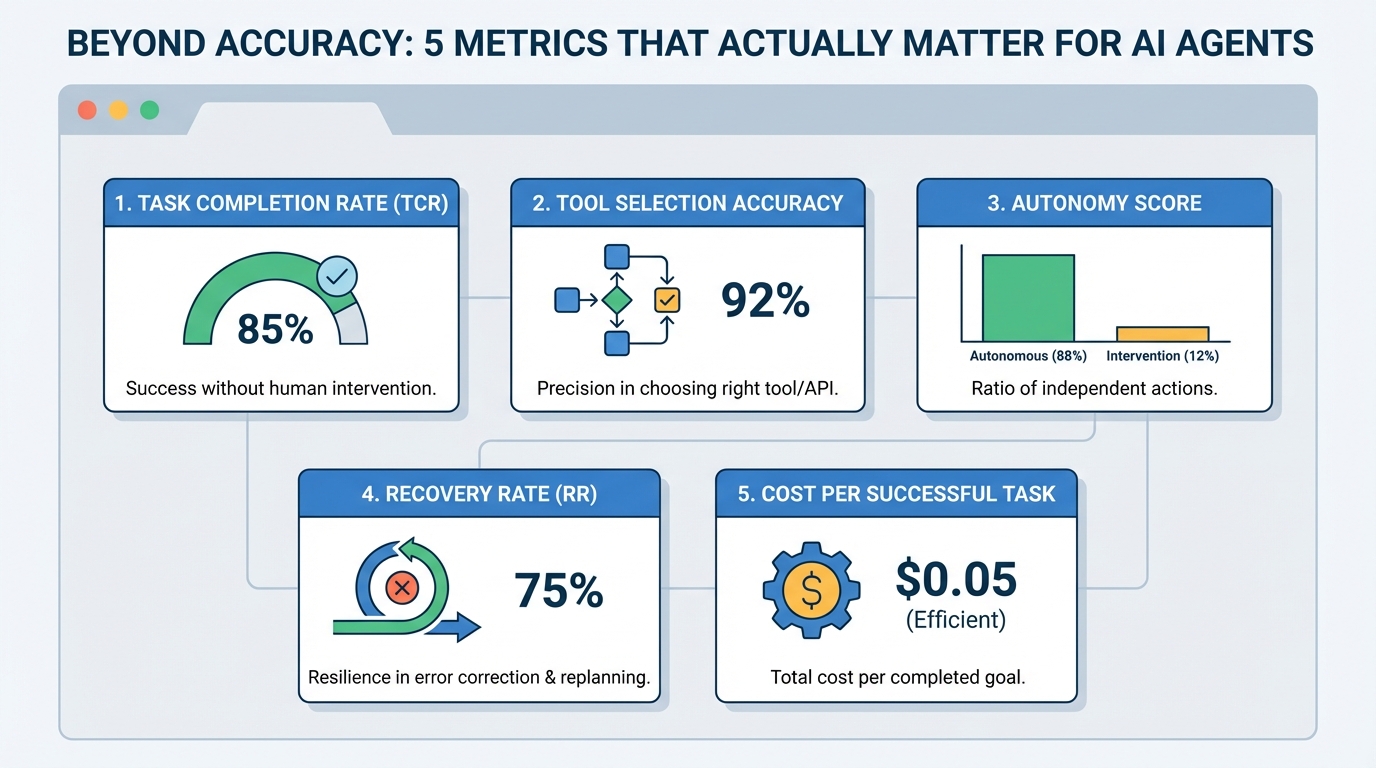
Beyond Accuracy: 5 Metrics That Actually Matter for AI Agents
AI agents , or autonomous systems powered by agentic AI, have reshaped the current landscape…

Think Smaller: The Counterintuitive Path to AI Adoption
The following article originally appeared on Gradient Flow and is being reposted here with the…

“Robot, make me a chair”
An AI-driven system lets users design and build simple, multicomponent objects by describing them with…