


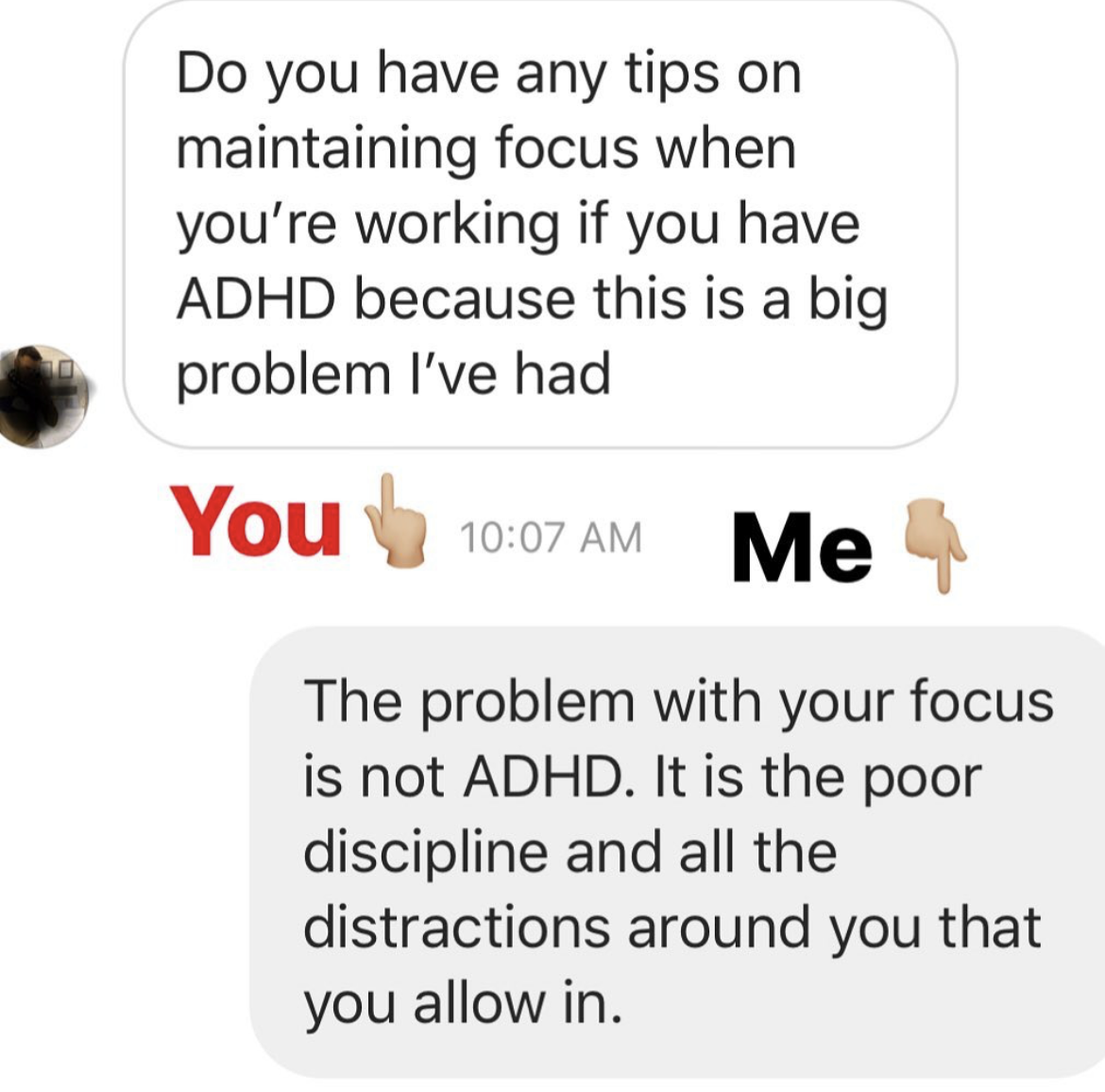
A good article on ADHD by Emma Baker of Tree Number Three from Inkhaven. ADHD can be uniquely debilitating and also complicated to effectively medicate, and this article changed my perspective on how bad it is. In this post I’ve included some personal commentary from my own experiences on Emma’s article. On how ADHD is actually terribleI often observe ADHD romanticized as a quirky harmless disorder or failure of will, but this hurts people with ADHD since thinking it’s good or merely a willpower issue discourage those with the disorder from seeking effective treatment. Meanwhile the disorder can seriously impair life outcomes.I’ve recently realized ADHD is much worse than the average person assumes. It’s worse than I assumed. I think treating a disclosure of ADHD with more gravity — not mythologization, simply weight — might make life better for those with ADHD and those without it.I wholeheartedly support the reduction of stigma for those with mental illness, and believe that the mentally ill benefit from public awareness of their conditions. It is also fun when people who know what they’re talking about joke about it.However.My own experience inclines me to agree with Dr. Russell Barkley, who famously called ADHD “degenerative diabetes of the brain.” It is not Fidgeting in Your Seat Disorder. We are not indigo children; we are not Bart Simpson. The never-ending parade of famous people talking about their ADHD seems to imply that there is an equal chance for those with and without ADHD to succeed in most domains. Untreated, there is not.In addition to ADHD being reduced to something simply amusing and not actually deeply impairing, like with the Bart Simpson comparison, I think the notion that ADHD has some set of advantages is also quite harmful. While sometimes successful people say that their ADHD helped them avoid a traditional career path and motivated them to pursue something unique, we 1) have no counterfactual to prove they wouldn’t be successful with treatment, 2) can look at how hurtful ADHD is towards life outcomes statistically (very) — which, in my opinion, strongly suggests this idea is deeply harmful. I also see things like this:While I appreciate the sentiment, this kind of rhetoric does not often help people with ADHD. It would be extremely useful to hear more if it were true that ADHD was simply a byproduct of a lack of conviction, but this is a convenience we’re not afforded.Also, the above does kind of reduce to “the problem with your focus is not your medically diagnosed focus impairment, it’s actually your poor ability to focus.”On the difficulty of treatment – medication does not work like glassesYes, Emma, you say, but ADHD is one of the most treatable conditions. Studies show that meds help a lot.Correct. And:Not all medications work like putting on glasses. Most people with ADHD need to find the “right” meds at the “right” dosage. This means:remembering to take themremembering to take them consistentlymanaging interactions with sleep, appetite, menstrual cycleand/or other medicationsremembering your reactions to themscheduling appointmentsremembering to show upAyyyy Macarena!Meds are life-changing. They rock. Due to the stuff I listed above, however, they don’t rock in the same ways for everyone all the time.And for a substantial but quiet number of people, they do not rock at all.As someone who suffers from ADHD myself, I personally have found no long-term sustainable medication for my ADHD despite trialing about six, and find it basically impossible to sit through a book or longer text unmedicated, let alone lecture or class. While I can read without aid, it is typically incredibly frustrating and takes much longer for me than normal people to read the same length of text. I have also learned everything in every class, with close to zero exception, by asking questions during office hours about problem sets (and recently LLMs). This is an effective way to learn ADHD-or-not but I would like to be able to learn from lectures as well.Others in my family with ADHD have taken nearly eight years to graduate four-year degree programs or otherwise fail classes regularly despite standardized test scores that would suggest better outcomes in college. I personally graduated high school by the skin of my teeth and then failed out of the first college I went to. That led to enormous problems for me and years of shame-induced irritable mood. Reflecting on that time, I feel I treated others badly and though ADHD is no excuse for that, I feel had I treatment during that time, I would have been a better person. One of my cousins has valid career-related reasons to not seek proper diagnosis or medication, which have made his career progression much more difficult. If you think you might have ADHD, I’d highly suggest reading Emma’s article for a good framework on how to relate to it, and looking into treatment. Life could be much easier for you (potentially).Discuss Read More
Emma Baker on ADHD
A good article on ADHD by Emma Baker of Tree Number Three from Inkhaven. ADHD can be uniquely debilitating and also complicated to effectively medicate, and this article changed my perspective on how bad it is. In this post I’ve included some personal commentary from my own experiences on Emma’s article. On how ADHD is actually terribleI often observe ADHD romanticized as a quirky harmless disorder or failure of will, but this hurts people with ADHD since thinking it’s good or merely a willpower issue discourage those with the disorder from seeking effective treatment. Meanwhile the disorder can seriously impair life outcomes.I’ve recently realized ADHD is much worse than the average person assumes. It’s worse than I assumed. I think treating a disclosure of ADHD with more gravity — not mythologization, simply weight — might make life better for those with ADHD and those without it.I wholeheartedly support the reduction of stigma for those with mental illness, and believe that the mentally ill benefit from public awareness of their conditions. It is also fun when people who know what they’re talking about joke about it.However.My own experience inclines me to agree with Dr. Russell Barkley, who famously called ADHD “degenerative diabetes of the brain.” It is not Fidgeting in Your Seat Disorder. We are not indigo children; we are not Bart Simpson. The never-ending parade of famous people talking about their ADHD seems to imply that there is an equal chance for those with and without ADHD to succeed in most domains. Untreated, there is not.In addition to ADHD being reduced to something simply amusing and not actually deeply impairing, like with the Bart Simpson comparison, I think the notion that ADHD has some set of advantages is also quite harmful. While sometimes successful people say that their ADHD helped them avoid a traditional career path and motivated them to pursue something unique, we 1) have no counterfactual to prove they wouldn’t be successful with treatment, 2) can look at how hurtful ADHD is towards life outcomes statistically (very) — which, in my opinion, strongly suggests this idea is deeply harmful. I also see things like this:While I appreciate the sentiment, this kind of rhetoric does not often help people with ADHD. It would be extremely useful to hear more if it were true that ADHD was simply a byproduct of a lack of conviction, but this is a convenience we’re not afforded.Also, the above does kind of reduce to “the problem with your focus is not your medically diagnosed focus impairment, it’s actually your poor ability to focus.”On the difficulty of treatment – medication does not work like glassesYes, Emma, you say, but ADHD is one of the most treatable conditions. Studies show that meds help a lot.Correct. And:Not all medications work like putting on glasses. Most people with ADHD need to find the “right” meds at the “right” dosage. This means:remembering to take themremembering to take them consistentlymanaging interactions with sleep, appetite, menstrual cycleand/or other medicationsremembering your reactions to themscheduling appointmentsremembering to show upAyyyy Macarena!Meds are life-changing. They rock. Due to the stuff I listed above, however, they don’t rock in the same ways for everyone all the time.And for a substantial but quiet number of people, they do not rock at all.As someone who suffers from ADHD myself, I personally have found no long-term sustainable medication for my ADHD despite trialing about six, and find it basically impossible to sit through a book or longer text unmedicated, let alone lecture or class. While I can read without aid, it is typically incredibly frustrating and takes much longer for me than normal people to read the same length of text. I have also learned everything in every class, with close to zero exception, by asking questions during office hours about problem sets (and recently LLMs). This is an effective way to learn ADHD-or-not but I would like to be able to learn from lectures as well.Others in my family with ADHD have taken nearly eight years to graduate four-year degree programs or otherwise fail classes regularly despite standardized test scores that would suggest better outcomes in college. I personally graduated high school by the skin of my teeth and then failed out of the first college I went to. That led to enormous problems for me and years of shame-induced irritable mood. Reflecting on that time, I feel I treated others badly and though ADHD is no excuse for that, I feel had I treatment during that time, I would have been a better person. One of my cousins has valid career-related reasons to not seek proper diagnosis or medication, which have made his career progression much more difficult. If you think you might have ADHD, I’d highly suggest reading Emma’s article for a good framework on how to relate to it, and looking into treatment. Life could be much easier for you (potentially).Discuss Read More
Related Posts

Key to Life No. 9: Access
There is now an enormous amount of incredibly useful information in the world. But at…
AI Science Companies: Evidence AGI Is Near
Published on October 6, 2025 10:13 AM GMTPeople routinely ask, “If AI labs believed AGI…
101 Humans of New York on the Risks of AI
Nobody has ever done an in person door to door survey about AI risks[1]. What…